What Happened Between the Physician Notes?
The Most Important Evidence in Your Case May Be Hidden in the Nursing Documentation
Every attorney has done it.
You receive thousands of pages of medical records and immediately turn to the physician documentation—the emergency department note, the operative report, the specialist consult, the discharge summary. Those notes often form the backbone of the case.
But what happened in the hours between those physician notes?
That's where the story often changes.
Physicians may document once or twice during a shift. Nurses document continuously. They record changes in condition, pain levels, medication responses, communication with providers, family concerns, falls, skin assessments, vital-sign trends, and countless clinical details that arise while the physician is caring for other patients.
In many cases, the nursing documentation provides the timeline that explains how an adverse event developed—not just that it occurred.
The Medical Record Isn't Lying...
One of the biggest misconceptions is that the medical record tells a single, objective story.
It doesn't.
The medical record is a collection of observations made by different healthcare professionals, at different times, for different purposes. Each clinician documents through the lens of their role.
That means seemingly conflicting documentation is not uncommon.
For example:
A physician documents:
"Patient resting comfortably."
Thirty minutes earlier, the nurse documented:
"Patient reporting severe pain rated 9/10, grimacing, unable to get comfortable despite repositioning."
Which one is correct?
Possibly both.
The physician observed the patient during a brief encounter. The nurse cared for the patient throughout the shift and documented events as they occurred.
Another example:
Physician note:
"No acute distress."
Nursing documentation:
"Oxygen saturation decreased to 82% while ambulating. Physician notified. Oxygen increased to 4 L/min."
Or:
Therapy note:
"Patient ambulated 150 feet with walker."
Nursing documentation:
"Required two-person assist to transfer from bed. Became dizzy after standing. Returned safely to bed."
None of these entries necessarily contradict each other. Instead, they illustrate why reviewing only physician documentation can leave important pieces of the clinical picture undiscovered.
Where Cases Are Often Won—or Lost
Nursing documentation frequently answers questions that physician notes cannot.
Questions such as:
- When did the patient's condition actually begin to deteriorate?
- Were abnormal vital signs recognized and documented?
- Was the physician notified promptly?
- How long was there a delay before new orders were received?
- Did the patient's pain remain uncontrolled despite treatment?
- Were family members expressing concerns before the adverse event?
- Were pressure injury prevention measures documented consistently?
- Did nurses identify subtle neurological or respiratory changes hours before a crisis occurred?
Those details often become critical when evaluating standard of care, causation, and damages.
Looking Between the Notes
Think of physician documentation as snapshots.
Nursing documentation is the video.
The physician's note may tell you where the patient was at a particular moment. The nursing record often reveals everything that happened before and after that encounter.
That's why timelines become so important.
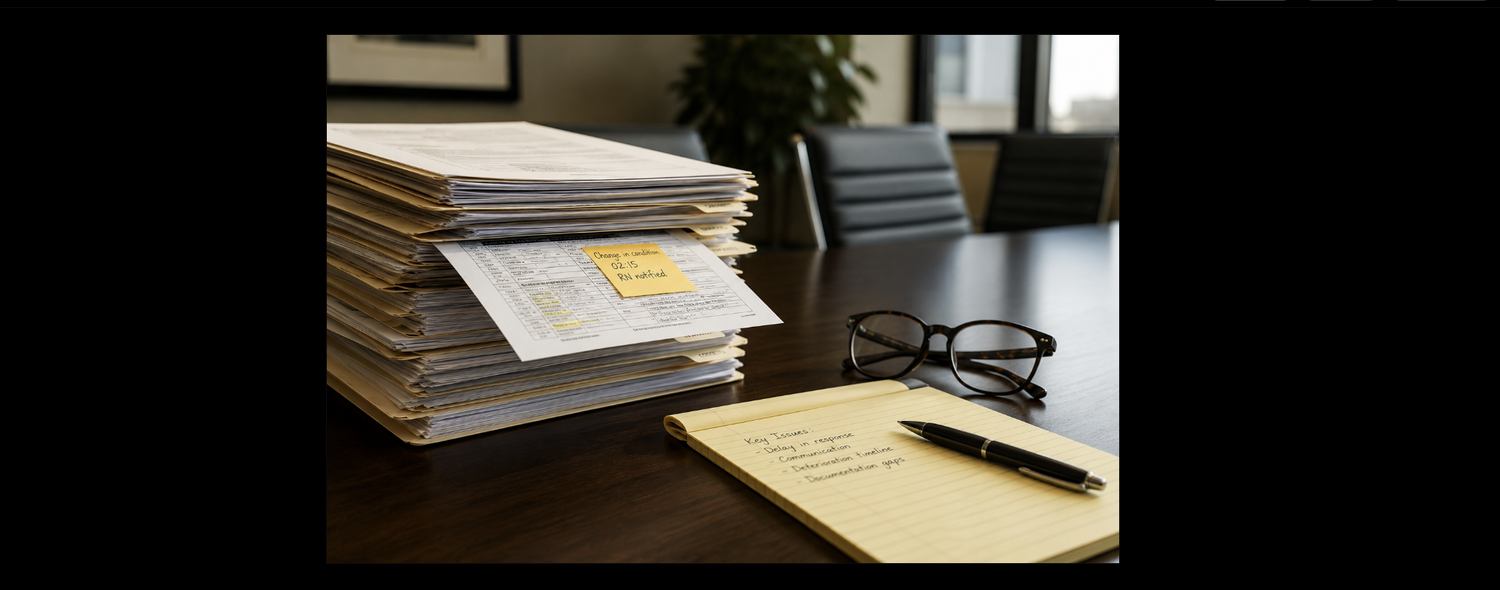
A physician may document that a patient was stable during morning rounds. Hours later, the patient experiences a significant decline. Without reviewing the nursing documentation in between, it's impossible to understand when the first warning signs appeared, how staff responded, and whether opportunities for intervention were missed.
Why It Matters
Attorneys don't need to become nurses.
But they do need someone who understands where these clinical details are documented and how they fit together.
A thorough review of the nursing documentation can reveal delays, communication breakdowns, evolving symptoms, inconsistencies, or trends that may never appear in a physician's narrative.
Sometimes the strongest evidence in a case isn't hidden because someone intended to conceal it.
It's hidden because no one has looked closely enough between the physician notes.
That's where some of the most important pieces of the story are waiting to be found.
Medical records rarely tell their story in chronological order. One of the most valuable contributions a legal nurse consultant can make is organizing the clinical timeline so the sequence of events—and the significance of those events—becomes clear.